
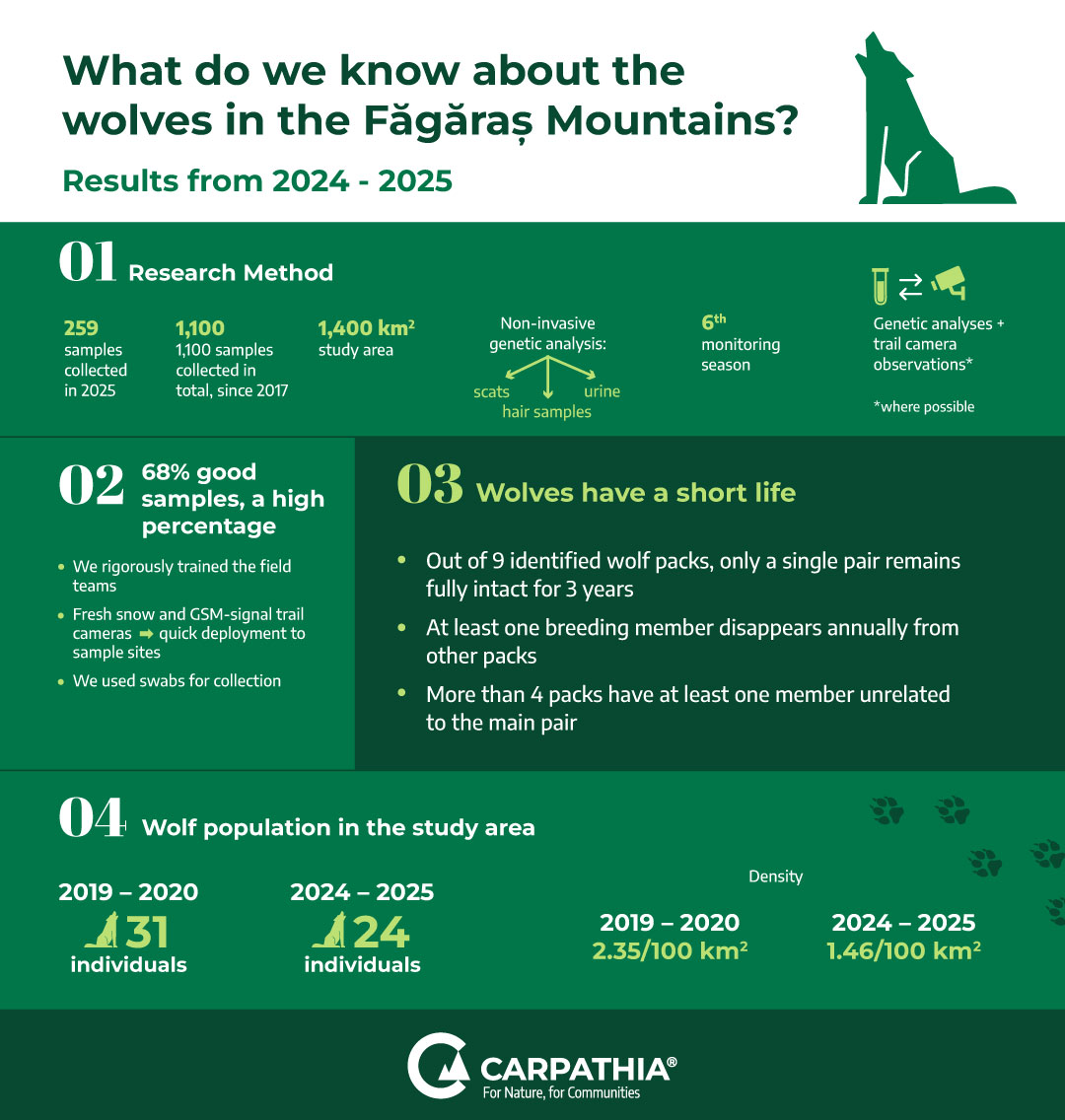
Genetic monitoring carried out by Foundation Conservation Carpathia in the Southern Carpathians is providing new information about the structure and dynamics of the resident wolf population. During the 2024–2025 season, 24 wolves – 10 females and 14 males – were identified across an area of approximately 1,400 km². The data provide a clearer picture of relationships between individuals, pack dynamics and the way wolves use their territories.
The wolf monitoring programme, launched by Foundation Conservation Carpathia in 2017, is carried out in the Southern Carpathians across six hunting grounds in the Făgăraș, Iezer-Păpușa and Leaota Mountains, as well as within Piatra Craiului National Park. Monitoring is based on non-invasive methods, using DNA extracted from biological samples collected in the field, including urine from snow, scat and hair.
The analyses allow researchers to identify individual wolves, estimate population size, reconstruct family relationships and approximate the territories used by different packs, while also showing how the population is organised and changes over time.
Data are collected every winter. During the 2024–2025 season, field teams collected 259 DNA samples, bringing the total to 1,100 samples over the past seven years, a monitoring effort unique in this part of Europe. Collection and analysis techniques have been continuously improved, and the genetic identification rate has reached 68.7%, comparable to that achieved in similar studies in Western Europe and North America.
The use of camera traps, which transmit images from the field, has also contributed to this result. They help teams determine more quickly when and where wolves are moving, increasing the chances of locating biological samples.
The latest genetic analysis identified 24 wolves – 10 females and 14 males. The six families, or packs, previously known in the area have reorganised, at least temporarily, into nine smaller packs. Several solitary individuals were also identified, originating both from known packs and from outside the study area.
This indicates that, despite reduced social stability, the Southern Carpathian landscape remains sufficiently connected to allow wolves to travel long distances and maintain natural genetic exchange between packs. Wolves can travel an average of around 20 kilometres per day, while their annual movements can sometimes exceed 1,000 kilometres.
Another important finding from the genetic analyses concerns hybridisation between wolves and dogs. One such case was documented in the project area in 2019, but no further cases of hybridisation have been identified in recent analyses, which is a positive sign for the genetic health of the wolf population in this area.
 Why is wolf monitoring important?
Over recent decades, wolves have returned to many European countries, and significant populations can now be found in countries including Italy, France, Germany and Bulgaria, as well as in Romania. With this return, more and more countries need to find solutions for coexistence with the species, while wolves themselves must adapt to landscapes that have changed significantly during the period in which they were absent from certain regions.
In this context, long-term monitoring is essential for understanding how the population is changing and for making informed decisions about the management of the species.
At the same time, data obtained through credible, transparent and replicable methods can help build trust between communities and the different stakeholders involved. When there is a shared basis of information, discussions about wolf management can move away from confrontation and towards the dialogue and negotiation needed to develop coexistence solutions together.
Reduced social stability within packs
The study also highlights a complex and dynamic social structure. While some packs maintain their territories over several years, others reorganise or split into new groups.
Researchers have also observed almost annual changes in breeding pairs, something that would not normally be expected in this predominantly monogamous species. Of the nine families identified during the latest season, only one retains the same breeding pair as in previous years. In the other cases, one of the partners has been replaced or the breeding pair could no longer be identified.
In terms of wolf population density, an estimated 1.46 wolves per 100 km² were recorded in the winter of 2024–2025, compared with 2.35 in the winter of 2019–2020. At the same time, the number of identified individuals has declined, while packs have become more numerous but smaller.
Taken together, these data may indicate the loss of mature and experienced individuals from the population, although it is not yet known whether this is due to natural or human-related causes. Researchers emphasise that at least 10–15 years of monitoring are needed before a population trend can be established.
The effects of this type of instability are difficult to predict. The loss of experienced individuals and frequent changes in pack structure may increase the risk of interactions between wolves and people.
Young wolves that are less experienced hunters, as well as packs undergoing reorganisation, may look for new territories and more easily accessible food sources. Studies from other regions show that high mortality among wolves, including as a result of hunting or poaching, can destabilise pack structure and increase the risk of attacks on livestock.
How genetic analysis and camera traps complement each other
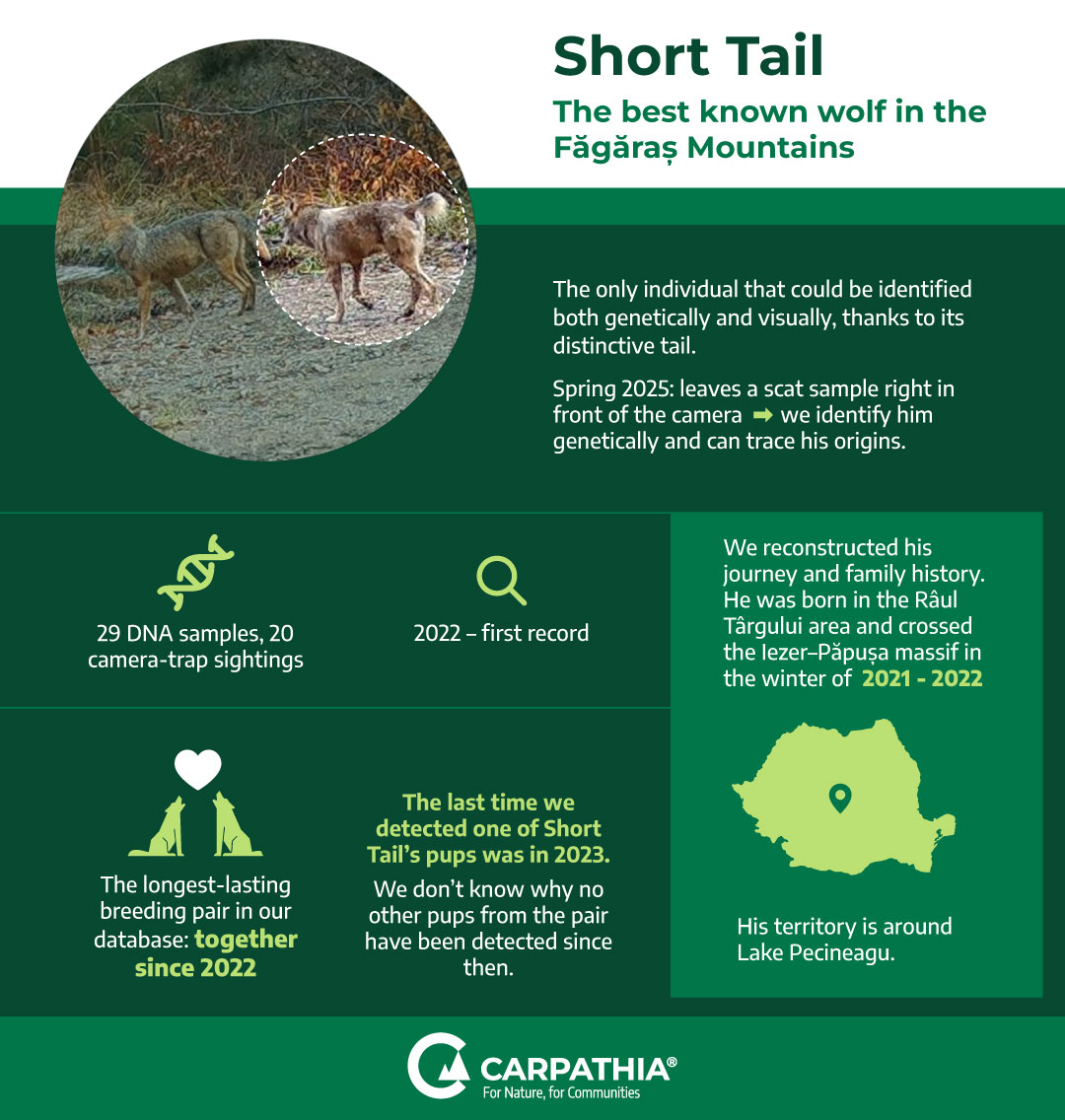
The case of a male wolf known as ‘Short Tail’ illustrates how much information can be obtained when genetic analysis is combined with images captured by camera traps.
First observed in 2022 because of his distinctive appearance, marked by his damaged tail, he has since been detected 29 times through DNA samples and 20 times by camera traps.
By correlating these data, researchers were able to reconstruct his family history in the Râul Târgului–Lake Râușor area, as well as the route he travelled towards Lake Pecineagu, in the Dâmbovița Valley. Since 2022, ‘Short Tail’ has formed the longest-lasting breeding pair documented in the study.
His family uses a territory of approximately 250 km², stretching from the headwaters of the Dâmbovița River and the Bârsa Valley to the area near the town of Zărnești, crossing the Piatra Craiului Mountains.
 The ecological and social role of the wolf. Coexistence between people and wolves
The wolf acts as a true architect of the landscape, triggering cascading effects that influence entire ecosystems. By regulating populations of herbivores such as wild boar, red deer and roe deer, wolves reduce overgrazing, support forest regeneration and help maintain the diversity of plants and other species.
Their presence also creates a ‘landscape of fear’, changing the behaviour of the animals they prey on as well as that of other carnivores. To avoid encounters with wolves, these animals alter their movements and the way they use the landscape, reducing pressure on sensitive areas such as river floodplains.
This role can also be seen in wolves’ relationship with other carnivores. A recent Europe-wide study shows that golden jackals expand more easily into areas where wolves are absent. In the Southern Carpathians, where wolves are present, golden jackals have been detected only occasionally, twice in eight years, with no indication that they have established themselves in the project area.
These observations highlight the wolf’s role in regulating relationships between predators and maintaining ecosystem balance.
Wolves also have a scavenging role: they consume dead animals, while the remains of their prey provide food for other species, including ravens, foxes and invertebrates, contributing to nutrient cycling in nature.
Conflicts between wolves and livestock farmers are a challenge in many parts of Europe. In the Carpathian Mountains, however, traditional prevention methods are still used, including shepherds staying with their flocks, the use of local breeds of livestock guardian dogs, and keeping animals overnight in enclosures protected by wooden or electric fencing.
Only 30 incidents attributed to wolves have been recorded in Foundation Conservation Carpathia’s project area over the past seven years, an average of three to four cases per year. Losses of sheep were compensated in kind by the Foundation, which provided livestock farmers with the same number of sheep as had been killed by wolves.
These traditional practices need to be continued and supported by measures that help local communities coexist more successfully with wolves: effective implementation of livestock compensation schemes, support for local breeds of livestock guardian dogs, improved management of organic waste and stray dogs, and measures to prevent and penalise poaching.
For many people, the presence of wolves is a sign of wild and well-preserved nature and can become part of a region’s identity. Although seeing wolves in the wild is difficult, their presence in a landscape indicates that functioning ecosystems still remain and can increase the area’s appeal for nature-based tourism.
The wolf also has strong cultural and symbolic significance in Romania. It has been present for centuries in folklore, mythology and traditions and forms part of a natural and cultural heritage worth preserving for future generations.